I applaud the recent 2026 efforts to update the Centers for Disease Control and Prevention (CDC)’s childhood immunization recommendations, particularly the stated emphasis on informed consent and empowering the public: “Increased emphasis on personalized medicine would improve informed consent and the doctor patient relationship, leading to a better educated and empowered public. The increased emphasis on shared clinical decision-making would help restore trust in public health recommendations made by CDC.”
I also am grateful for the U.S. Department of Health and Human Services (HHS)’s stated priority that “unbiased science—evaluated through a transparent process…guides the recommendations and programs of our health agencies.”
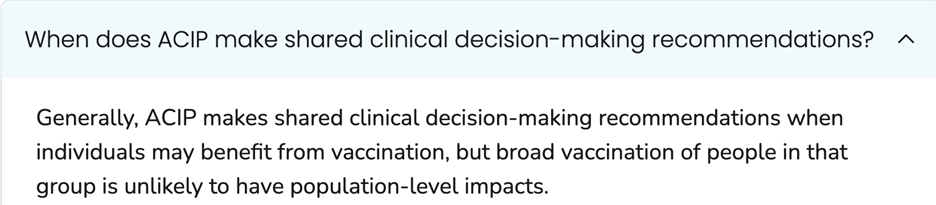
At the same time, it is important to recognize a key distinction in how vaccine recommendations are made. “Individually based” shared clinical decision‑making (SCDM) recommendations are generally reserved for situations in which “broad vaccination of a group is unlikely to have population – level impacts.”
Another category of vaccines—often referred to as “routine,” and now designated as “Immunizations Recommended for All Children” — is recommended, in part, on the basis of population – level impacts. These recommendations are therefore not solely focused on the benefit – risk ratio for an individual child.
This raises an important question: how is informed consent supported when population – level impacts are part of the recommendation itself? To answer that, it helps to understand how routine vaccine recommendations are developed.
Following initial approval by the U.S. Food and Drug Administration (FDA), the CDC’s Advisory Committee on Immunization Practices (ACIP) issues recommendations regarding which populations should receive a given vaccine. As of this writing, the agenda for the March 18–19 meeting of ACIP has not yet been published. However, it is reasonable to anticipate that one topic of discussion may involve changes to the committee’s recommendation methodology. The ongoing ACIP Recommendation Methodology Review Workgroup has been charged with examining the historical use of, and potential revisions to, ACIP frameworks, including the Grading of Recommendations Assessment, Development and Evaluation (GRADE) framework (2010) and the Evidence – to – Recommendation (EtR) framework (2018).
What the EtR framework means by “Balance of Consequences”
Within the EtR framework, the “balance of consequences” refers to the weighing of desirable and undesirable consequences at both the individual and population levels.
Work group judgments assess:
Desirable effects (benefits) at the individual level (ex: duration of protection) and at the population level (ex: herd immunity) alongside…
Undesirable effects (harms or risks) at the individual level (ex: adverse events) and at the population level (ex: serotype replacement).
These judgments contribute to the final ACIP recommendation.
Why this matters for informed consent
For routine vaccines—those recommended in part on the basis of population – level impacts— the underlying concept remains the same regardless of whether GRADE, EtR, or another framework is used: individual benefits and risks are considered alongside those of the population. Parents and guardians therefore should be able to understand how those considerations inform recommendations
Here, it is important to separate what the law requires from what ethically robust informed consent should include.
The CDC explains that there is no federal requirement for informed consent related to vaccination. At the same time, Vaccine Information Statements (VISs) are required by law for vaccines covered under the National Childhood Vaccine Injury Act, and must be provided prior to vaccination (and prior to each dose in a multi‑dose series).
The CDC also states that VISs “cover both benefits and risks associated with vaccinations” and that VISs may be used for informed consent as long as they conform to applicable state laws. But current VISs do not explicitly describe in a way accessible to patients or parents how routine vaccine recommendations differ from other individually based medical decisions—specifically, how benefits and harms are assessed at both the individual and population levels.
That distinction matters all the more because the HHS assessment on the childhood schedule emphasizes that “informed consent is a cornerstone of medical care” and that maintaining trust includes “being honest when the scientific knowledge is incomplete.” In other words, if informed consent and transparency are the goal, patient – facing materials should make clear not only what is known about the vaccine’s benefits and risks, but also how the recommendation itself is made when population – level effects are part of the calculus.
The same HHS assessment also states that vaccine safety and risks are often “poorly characterized, quantified, or understood,” and it calls for additional research on individual vaccines and vaccination schedules. Whatever one’s view of current vaccine policy, this reflects the importance of informed consent communicating both the current state of scientific knowledge and areas that remain under study.
Finally, informed consent is not only a conversation; it is also a process. As with other medical interventions, the informed consent process for vaccination can be documented in the medical record to reflect understanding of the intervention and its potential risks and benefits.
A practical next step: add two disclosures to VISs
In practice, parents are often told that vaccines protect both their child and the broader community. While this framing emphasizes altruism, truly empowering and educating parents requires additional transparency about the recommendation framework itself. Separately, ethically robust informed consent also includes acknowledgment that scientific evidence is subject to ongoing review and may be updated as additional information becomes available. One step toward fuller informed consent would be to include the following risk‑based disclosures in each Vaccine Information Statement:
Why this vaccine is recommended
This vaccine is recommended based on what is known about its benefits and risks for individual children and for the community as a whole.
What this means for your child
Because community – wide effects are considered, this recommendation may not be based only on the vaccine’s risks and benefits for your child.
About ongoing safety research
What is known about the vaccine’s risks and benefits continues to develop as more research is done. Studies over time improve understanding of both benefits and possible harms, and examine both individual vaccines and the recommended vaccine schedule.
These disclosures do not prescribe a particular decision. They align patient – facing information with how routine vaccine recommendations are made—including the fact that such recommendations can incorporate population – level considerations—supporting transparency and informed decision – making. Their purpose is to make the recommendation framework clearer to patients and parents, consistent with the public commitment, affirmed by HHS, to informed consent and honesty when scientific knowledge is incomplete.
From Recommendation to Disclosure reflects a renewed emphasis on transparency, trust, and informed consent in public health decision – making, while leaving open how individual and population – level interests are ultimately addressed in relation to one another.
The post From Recommendation to Disclosure: What Informed Consent Requires in Population – Level Vaccine Recommendations appeared first on DailyClout.
0 comments on “From Recommendation to Disclosure: What Informed Consent Requires in Population – Level Vaccine Recommendations” Add yours →